Bentonite Granules Production Process: From Powder to Uniform Granules

Bentonite is widely used in fertilizer, animal feed additives, soil conditioners, cat litter, and other industrial applications. However, raw bentonite powder is often dusty, difficult to transport, and inconvenient for accurate dosing. Turning powder into uniform granules can improve handling, reduce dust, and increase product value. For many manufacturers, understanding the right bentonite granules production line is the first step toward building a stable and profitable processing system.

Why Granulate Bentonite Powder?

Bentonite powder has strong absorbency and binding properties, but fine powder can easily cause material loss during storage, mixing, and packaging. Granulation helps convert loose powder into particles with better flowability and more consistent size. This is especially important for fertilizer plants, mineral processing companies, cat litter producers, and agricultural material suppliers.

Uniform granules also make it easier to control packing weight, improve product appearance, and meet different market requirements. Depending on the final application, the granule size, hardness, moisture content, and shape can be adjusted through different equipment configurations.

Main Steps in the Production Process

The bentonite granules manufacturing process usually starts with raw material preparation. Bentonite powder may need crushing, screening, or moisture adjustment before granulation. If the powder is too dry, a proper amount of water or binder can be added to improve particle formation. If the raw material contains impurities or oversized particles, pretreatment is recommended.

After preparation, the material enters the granulation stage. Common granulation equipment includes disc granulators, rotary drum granulators, and double roller extrusion granulators. Disc and drum granulators are often used for wet granulation and can produce rounded particles. Double roller granulators are more suitable for dry granulation and can reduce the need for drying.

Once granules are formed, they may pass through drying, cooling, screening, and packing sections. Qualified particles are sent to packaging, while undersized or oversized materials can be returned for reprocessing.
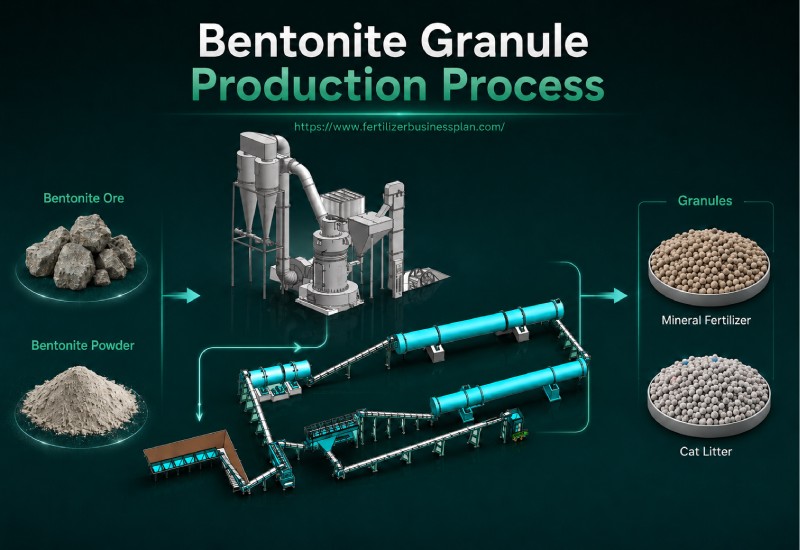
bentonite granules production solution

How to Make Uniform and Round Granules

Many buyers want to know how to make round bentonite granules because particle shape directly affects product appearance and market acceptance. In wet granulation, the key factors include suitable powder fineness, proper moisture control, stable feeding, and continuous rolling movement inside the granulator.

A disc granulator is often selected when customers need visually round granules. By adjusting the disc angle, rotating speed, water spraying amount, and feeding rate, operators can improve granule roundness and size consistency. For larger capacity projects, a rotary drum granulator can also be considered.

Choosing the Right Equipment

When searching for a bentonite granules making machine for sale, buyers should not only compare machine prices. They also need to consider raw material condition, target capacity, granule size, automation level, workshop space, and downstream packing requirements.

A small plant may only need a mixer, granulator, screener, and packing machine. A larger project may require a complete system with crushing, batching, drying, cooling, screening, dust collection, and automatic control.

Customized Plant Solution

Every bentonite project has different requirements. Moisture, fineness, capacity, energy supply, and final product use can all affect equipment selection. For investors planning an industrial bentonite granules manufacturing plant solution, it is better to design the process according to actual raw material tests and production goals.

A well-designed bentonite granulation system can help reduce dust, improve particle quality, support continuous production, and create more competitive finished products for fertilizer, agriculture, cat litter, and industrial markets. If you are interested in the project,  you can visit https://www.fertilizerbusinessplan.com/bentonite-granules-production-process/

How to make bentonite pellets in disc pelletizer


Bentonite is a type of clay that has numerous uses in various industries, from drilling fluids in the oil industry to binder materials in the manufacturing of iron ore pellets. Pelletizing bentonite is an essential process to enhance its handling and application. A disc pelletizer is one of the tools used for this purpose, providing a method to convert bentonite powder into useful, uniformly-sized pellets. This comprehensive guide will walk you through the process of making bentonite pellets using a disc pelletizer.

Understanding Bentonite and Its Applications

The Unique Properties of Bentonite

Bentonite is known for its ability to swell and increase viscosity when mixed with water, which makes it a valuable material in many industries. Its absorbent and adhesive properties also make it suitable for use in environmental protection as a liner material for landfills.

Diverse Industrial Uses

In agriculture, bentonite is used as a soil conditioner. In the construction industry, it is utilized as a sealant. It is also a choice substance in the pharmaceutical field for its absorbent qualities and in the pet industry as a component of cat litter.

Preparing Bentonite for Pelletizing

Bentonite Powder Selection

For pelletizing, you must start with high-quality bentonite powder. Ensure that the powder is free from impurities and is of a consistent size. The moisture content of the powder should be controlled to optimize the pelletizing process.

Moisture Content Adjustment

Before the pelletizing process begins, adjust the moisture content of the bentonite powder, if necessary. The ideal moisture level is critical for pellet formation, as too much or too little moisture can lead to weak pellets that easily disintegrate.

The Pelletizing Process in a Disc Pelletizer

Setting Up the Disc Pelletizer

The disc pelletizer, also known as a pan granulator machine, is a circular, shallow, pan-like machine that has a slightly angled base. To prepare for pelletizing, ensure the disc is clean and set at the appropriate angle and rotational speed according to the manufacturer’s specifications.

The Feed

Introduce the bentonite powder into the disc pelletizer. The rotational movement of the disc causes the material to roll and gather, gradually forming small pellets. It’s crucial to feed the powder at a consistent rate to maintain an even distribution in the disc.

The Role of Binders and Additives

Enhancing Pellet Durability

Binders or additives are often added to the mix to enhance the durability and hardness of the pellets. For bentonite, additional binders might not be necessary due to its inherent binding properties, but in some cases, they may be used to meet specific industry standards.

Mixing Homogeneously

Any binders or additives should be mixed thoroughly with the bentonite powder before the pelletizing process to ensure uniform distribution within the pellets.

The Growth Phase of Bentonite Pellets

Nucleation and Growth

As the disc rotates, small particles stick together to form what is known as “nuclei” or “seeds.” These gradually grow in size as they pick up more material while rolling around in the disc. The process of layering and consolidation under the forces of rotation is known as coalescence.

Controlling Pellet Size

The size of the pellets can be controlled by adjusting the amount of material fed, the rotation speed of the disc, the angle of the pan, and the duration of the pelletizing process. It is important to balance these factors to achieve the desired pellet size.

disc pelletizer for pellets with water spray

Post-Pelletizing Treatments

Drying the Pellets

After forming, the pellets may require drying to remove any excess moisture. This can be done using a rotary dryer or by spreading the pellets out in a thin layer to air dry.

Screening and Separating

Once dry, the pellets are typically screened to separate and recycle fines or oversized pellets. The correctly sized pellets are collected and can be further processed or packaged for storage and transport.

Quality Control and Storage

Ensuring Consistent Quality

Throughout the pelletizing process, it is crucial to monitor pellet quality. Regular checks should be made for pellet size, shape, moisture content, and strength to ensure consistency and to meet any industry-specific requirements.

Proper Storage Techniques

Store the finished bentonite pellets in a dry, well-ventilated area to prevent moisture absorption and degradation. Packaging in air-tight bags or containers can also help maintain pellet quality during transportation and storage.

Conclusion: Bentonite Pellets Ready for Use

Using a disc pelletizer to form bentonite pellets is an efficient and effective way to prepare this versatile clay for a multitude of industrial and commercial uses. The process requires attention to detail, from selecting the right raw material and controlling moisture content to fine-tuning the pelletizer settings and performing quality control. By following these steps, you can produce high-quality bentonite pellets that are ready for a variety of applications, contributing to the smooth operation of diverse industrial processes.