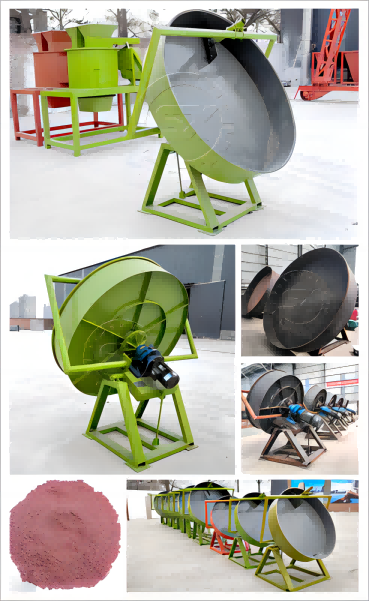
Органические удобрения играют ключевую роль в устойчивом сельском хозяйстве, обеспечивая растения необходимыми питательными веществами и улучшая структуру почвы. Грануляторы для органических удобрений являются важным элементом в производстве удобрений, так как они позволяют преобразовать сыпучие материалы в гранулированную форму, что облегчает хранение, транспортировку и применение.
Гранулятор-дисковый представляет собой машину, в которой используется вращающийся диск с определенным углом наклона и скоростью вращения, чтобы смешать сырье и формировать гранулы определенного размера. Процесс гранулирования происходит благодаря центробежной силе, возникающей при вращении диска.
Тарельчатый гранулятор с несколькими углами
Особенности гранулятора-дискового:
1. Угол наклона диска: Угол наклона диска может быть регулируемым, что позволяет контролировать размер гранул и обеспечивает гибкость процесса производства.
3. Материалы для гранулирования: Гранулятор способен работать с различными органическими материалами, такими как навоз, компост, торф и другие органические отходы.
4. Эффективность и производительность: Машины обычно характеризуются высокой производительностью и могут производить гранулы с хорошо сбалансированным содержанием питательных веществ.
5. Конструкция: Грануляторы-дисковые имеют простую и надежную конструкцию, что облегчает их обслуживание и долговечность.
Внедрение таких технологий, как гранулятор-дисковый для органических удобрений, способствует расширению возможностей современного агропромышленного комплекса, повышению эффективности использования органических отходов и улучшению экологической обстановки в целом. Чтобы узнать больше о дисковом грануляторе, посетите:https://www.sxmashina.com/tarelchatyy-granulyator/
Investing in an organic fertilizer plant can cultivates sustainability, meets market demands, and grows profits. However, for prospective investors and entrepreneurs considering entry into this fertilizer industry, the burning question remains: How much does it cost to start a fertilizer production plant cost?
Fertilizer Plant Setup
1. Cost of Infrastructure and Plant Setup
The first major expense when setting up a fertilizer production plant is acquiring suitable land and constructing the required infrastructure. The plant layout, facilities, and processing units are essential considerations. Costs associated with land rents, building construction, and installation of necessary equipment can vary significantly depending on the plant’s size and capacity.
Small-scale fertilizer factory construction may require a lower upfront cost, focusing primarily on essential machinery and storage units. On the contrary, larger plants may demand more substantial investments to accommodate the increased production capacity.
Fertilizer Production Workshop Construction
2. Cost of Fertilizer Manufacturing Equipment
Investing in quality manufacturing equipment and machinery is crucial for efficient production. To find a famous fertilizer equipment manufacturer, such as and fertilizer granulators, SX drying machines and packaging machinery, each equipment contributes to the overall efficiency of the production process. The choice of equipment will depend on the type of fertilizer, production capacity, and level of automation. Shunxin provides a lot of manufacturing plans according to customers’ needs, 1-2 t/h, 5-8 t/h, 10 t/h, or 20t/h.
Budgeting for the purchase of equipment is necessary for accurate cost estimation. Investing in modern, state-of-the-art equipment might initially require a higher capital outlay but often proves to be a wise decision in the long run. Enhanced precision, reduced energy consumption, and increased production rates are among the benefits that can outweigh the initial costs.
Fertilizer Production Machinery
3. Cost of Raw Materials
Understanding the raw materials needed for fertilizer production is integral to estimating the initial investment accurately. Organic fertilizers typically rely on biomass, animal manure, and other organic matter, while inorganic fertilizers may require chemicals like ammonia, phosphoric acid, and potash. The costs associated with sourcing these raw materials, along with transportation and storage, significantly affect to the initial investment. Additionally, transportation costs may arise if the selected raw materials are not readily available near the production facility.
Skilled and trained labor is essential for the successful operation of a fertilizer production plant. The cost of hiring experienced personnel, including technicians, operators, and administrative staff, should be considered. Moreover, investing in employee training programs and hiring experienced professionals may contribute to the initial investment but pays dividends in terms of operational efficiency and product quality.
Complying with regulatory requirements and obtaining permits is a crucial part of establishing a fertilizer manufacturing plant. Obtaining the necessary licenses, permits, and adhering to environmental regulations incur additional costs. However, compliance is not just a legal requirement; it’s an investment in the sustainability and reputation of the business.
Conclusion
Building a fertilizer plant requires a comprehensive understanding of the initial investment required, including infrastructure, raw materials, manufacturing equipment, labor, and compliance. While the upfront costs may seem substantial, it’s essential to view them as strategic investments in the long-term success and sustainability of the venture. Conducting a thorough cost analysis and seeking professional guidance from fertilizer equipment manufacturer can help entrepreneurs and investors make informed decisions and embark on a successful journey in the fertilizer production industry. Click here for more information: https://www.fertilizerproductequipment.com/fertilizer-manufacturing-plant-cost/
Chicken manure pellets are an organic fertilizer that provide a rich source of nutrients for plant growth. They are an eco-friendly way to recycle waste from poultry farms and improve soil health. Making chicken manure granular fertilizer involves a series of steps from raw manure collection to the final pelleted product that is easy to store, transport, and use.
The Importance of Chicken Manure as Fertilizer
Nutrient-Rich Organic Matter
Chicken manure is loaded with essential nutrients such as nitrogen, phosphorus, and potassium, which are beneficial for soil fertility and plant growth. It also contains micronutrients that are crucial for the overall health of plants.
Benefits of Pelletizing Manure
Pelletizing chicken manure makes it more convenient to handle, reduces odor, minimizes pathogens, and facilitates a slow release of nutrients into the soil.
Collection and Preparation of Raw Manure
Gathering Manure
The first step in making chicken manure pellets is to collect the raw manure from poultry farms. This can be done manually or with the use of automated systems.
Drying the Manure
Moisture content in the manure should be reduced to make the pelleting process efficient. Sun drying is a natural method, while mechanical drying can be done using rotary drum dryers.
Composting the Manure
The Composting Process
Composting is a critical step that helps in the breakdown of organic matter and the reduction of pathogens. The manure is piled and regularly turned to maintain aeration and moisture content conducive to microbial activity.
Monitoring and Control
Temperature, moisture, and aeration are monitored and controlled to ensure the composting process is effective. This stage can take several weeks to a few months, depending on the method used.
Crushing and Mixing
Grinding the Composted Manure
Once the manure is fully composted, it is ground into a fine powder using a crusher or hammer mill. This increases the surface area, making the nutrients more accessible for release when applied to the soil.
Adding Additional Ingredients
To enhance the nutrient content or to achieve a desired nutrient balance, additional materials such as bone meal, blood meal, or other organic materials can be mixed with the composted manure.
The Pelletizing Process
Forming the Pellets
After mixing, the fine composted manure is fed into a pellet mill. The mill has a die and roller system that compresses the manure into dense, cylindrical pellets. And disc granulation equipment or drum granulation equipment can also produce chicken manure pellets.
Cutting and Cooling
Once the manure is extruded through the die, the elongated strands are cut into pellets of a specified size and then cooled to solidify and stabilize them.
Post-Pelletizing Processing
Screening and Quality Control
The pellets are screened to remove any dust or broken pellets, ensuring uniformity in size and quality. This step is crucial for the marketability of the final product.
Conditioning the Pellets
Optionally, the pellets can undergo further conditioning to improve their hardness and durability. This may involve additional moisture control or the application of a coating that reduces dust and improves nutrient retention.
The chicken manure pellets are then bagged in suitable packaging material that protects them from moisture and facilitates easy handling.
Storing for Optimal Preservation
The bagged pellets should be stored in a cool, dry place to prevent deterioration and preserve their efficacy as a fertilizer.
Application and Use in Agriculture
Dosage and Method of Application
When applying chicken manure pellets to the soil, it is crucial to follow recommended dosage guidelines and application methods to prevent over-fertilization and potential harm to plants.
Benefits to Soil and Crops
Regular use of chicken manure pellets can help improve soil structure, enhance water retention, and provide a slow and steady release of nutrients, leading to healthier plants and increased yields.
Conclusion
Making chicken manure pellets is a sustainable way to manage poultry waste and provide an organic fertilizer option for farmers and gardeners. The process involves several steps from raw manure collection to composting, pelletizing, and packaging. By converting chicken manure into a user-friendly pellet form, we can make the most of this valuable organic resource, closing the loop in agricultural nutrient cycles and contributing to a healthier environment.
In the world of agriculture, NPK fertilizer stands as the cornerstone of modern farming, delivering the vital nutrients plants need to grow, thrive, and produce abundant yields. NPK stands for nitrogen (N), phosphorus (P), and potassium (K), the three most essential nutrients required by crops. The synthesis of these elements into a single, easy-to-use fertilizer has revolutionized the agricultural industry. Today, we’ll explore the fascinating process of transforming raw materials into NPK granules using sophisticated machinery and technological ingenuity.
Understanding NPK Fertilizer
Before delving into the manufacturing process, it’s crucial to comprehend why NPK fertilizer is so invaluable. Nitrogen is paramount for leaf growth, phosphorus for root development, flowering, and fruiting, while potassium is essential for overall plant health. The ratio of these nutrients can be customized to meet specific crop needs, and that’s where the manufacturing process comes into play.
Compound fertilizer manufacturing process
Step 1: Ingredient Selection and Preparation
The journey to creating NPK fertilizer starts with the procurement of the raw materials: ammonium nitrate, urea, ammonium chloride, phosphates, and potassium salts. These ingredients are carefully selected and prepared for processing. Depending on the desired NPK ratio, each material is measured and potentially ground into a uniform particle size to facilitate even mixing and granulation.
Step 2: Proportioning and Mixing
With the raw materials prepped, precise proportioning is critical. Electronic or mechanical scales ensure that the nitrogen, phosphorus, and potassium components are weighed accurately in accordance with the desired NPK formula. The ingredients are then introduced into a mixing unit, such as a horizontal blender or a vertical mixer, to create a homogeneous mixture. This step is pivotal because even distribution of nutrients is essential for making high quality NPK compound fertilizer.
Step 3: Granulation
Now we arrive at the heart of the process: granulation. The thorough mixture is fed into a granulator, which can be a SX rotary drum, an extruder, or a pan granulator, among others. The granulator applies mechanical force to the mixture, compacting it into uniform granules. The choice of granulator depends on the desired size, hardness, and shape of the final product. Water or steam may be added during the process to aid in the formation of granules. Go here for more details.
Step 4: Drying and Cooling
Fresh from the granulator, the NPK granules carry too much moisture, which might compromise their quality. Thus, drying machine is also important for NPK fertilizer plant setup, such as a rotary dryer, where heated air evaporates excess moisture. Following drying, the granules must be cooled to enhance their structural integrity and to reduce the risk of caking. This is typically performed in a rotary cooler or by natural air-flow cooling systems.
Step 5: Screening and Coating
After cooling down, the NPK granules are sized using a screening machine. Oversize or undersize granules are either crushed and recycled back into the system or discarded. The on-size granules might then be coated with a layer of liquid or powdered agents to improve their physical properties, like decreasing dust, enhancing nutrient release rates, or reducing hygroscopicity.
Step 6: Packaging and Storage
The final step in the NPK fertilizer production process is packaging. The finished granules are loaded into bags or bulk containers, sealed to protect them from moisture and contamination, and then stored in a dry, cool place until they are ready for distribution.
NPK fertilizer granulator for sale
The Role of Machines in NPK Fertilizer Production
Throughout this process, specialized machinery ensures efficiency, accuracy, and quality control. Automated systems and sensors monitor every step, from raw material handling to the final product packaging, to ensure that the fertilizers meet strict industry standards.
The advantages of preparing NPK fertilizers with machines are manifold: they offer consistent nutrient content, ease of application, and improved crop performance. Moreover, the production process is highly scalable, allowing manufacturers to meet the ever-growing demand for agricultural inputs.
Embracing Technology for a Green Future
The creation of NPK fertilizer using machines is a perfect blend of science and technology, leading to products that support the global food supply chain. By understanding and appreciating the complexity and precision of this process, we can recognize the true value that these fertilizers bring to our tables. If you are interested in NPK fertilizer making, you can visit https://www.manuremanagementplan.com/npk-fertilizer-plant/
As agricultural practices continue to evolve, so too will the methods of fertilizer production. By investing in and advancing these technologies, we are not just improving the efficiency of farming; we are also taking active steps towards sustainable agriculture that can feed the world while preserving our natural resources for generations to come.
In the dynamic landscape of poultry farming and livestock husbandry, finding sustainable solutions for waste management is crucial. So you can have a try — chicken manure drying equipment, particularly well-suited for large, medium, and small-scale chicken farms and regions with a thriving livestock industry.
Chicken Manure Drying Device
Adaptable Heat Sources for Optimal Drying
Chicken manure dryer is a versatile solution that can cater to different drying requirements. Among the all machines on the market, Shunxin’s chicken manure dryer, depending on the product specifications, employ various alternative heat sources, such as gas generators, direct-fired hot air furnaces, indirect hot air furnaces, thermal oil, electric heating, biofuel particles and steam. Its adaptability ensures that the dung drying process adapts to the specific needs of the farm, providing efficiency and flexibility in operation.
Suitable Materials for Drying
This SX manure dryer is designed to handle materials with moisture content below 65%, the equipment is effective in drying a range of waste products, including chicken manure, duck droppings, poultry and livestock feces, and slaughterhouse by-products.
The rotary drum dryer for drying chicken manure comprises several essential components, including the heating source, feeding machine, rotary drum, material crushing device, discharge machine, induced draft fan, unloading device, and electrical control cabinet.
Chicken Manure Drying Process
The wet chicken manure, after undergoing screw dehydration treatment, is introduced into the drying machine. Within the rotating drum equipped with lifting boards, the droppings are uniformly distributed, promoting thorough contact with hot air.
As the feces tumbles inside the drum, it interacts with the heated air, accelerating the drying, heat transfer, and mass transfer processes. Throughout this journey, the inclined lifting boards and the heat stream work in tandem, guiding the material to the discharge valve at the other end of the drying machine. This efficient process results in the production of dry chicken manure, ready for various applications.
Components of Drum Dryer
Benefits and Applications of Chicken Manure Drying Equipment
1. Dry Chicken Manure’s Applications
In fact, SX chicken manure drum dryer is not just a waste disposal solution, for it transforms poultry waste into a valuable resource. For example, the finished products after manure drying process are suitable for fish feed, pig feed, fertilizer supplement, fruit tree fertilizer, and more. Additionally, the equipment contributes to dust and odor control, addressing environmental concerns associated with traditional waste management methods.
2. Features of SX Chicken Manure Dryer
The equipment can reduce the moisture content of fresh chicken manure from 70%-80% to below 10%.
The operation of the chicken dung drying machine is carried out in a fully enclosed state, contributing to waste utilization and energy conservation.
Conclusion
With its strong drying capabilities and practicality, coupled with the rapid development of the farming industry and increased demand for chicken manure compost, utilizing chicken manure rotary dryer provides significant advantages. It offers an excellent solution for the resource utilization and harmless treatment of farming waste, making it highly recommended for livestock enterprises and farmers. You can visit this page for more details: https://www.fertilizerdryer.com/chicken-manure-drying-machine/
Экологическая устойчивость: Продукты на основе тофу часто рассматриваются как более экологически чистые, так как они могут быть биоразлагаемыми и производиться с меньшим воздействием на окружающую среду.
Безопасность для кошек: Тофу является безопасным материалом, не содержащим химических добавок или ароматизаторов, что важно для здоровья и комфорта кошек.
Способность к удержанию запаха: Некоторые производители утверждают, что наполнитель из тофу обладает хорошей способностью удерживать запахи, что важно для поддержания свежести в районе кошачьего туалета.
Наполнитель для кошачьего туалета тофу
Меньшее количество пыли: Наполнители из тофу часто могут быть менее пыльными по сравнению с другими видами наполнителей, что может быть важным фактором для заботливых владельцев кошек и их здоровья.
Специфические требования рынка: Потребители все больше становятся осведомленными о своих покупках, и некоторые предпочитают выбирать продукты, которые соответствуют их экологическим ценностям.
Market Analysis: Assess the demand for biofertilizers in the target market.
Cost Analysis: Estimate the costs of biofertilizer making associated with land, equipment, raw materials, labor, and operational expenses.
Revenue Projections: Project potential revenues based on market demand and pricing.
Biofertilizer pellets making system for sale
2. Site Selection:
Location: Choose a bio fertilizer plant setup location that is easily accessible, complies with environmental regulations, and has adequate water and power supply.
Zoning and Permits: Obtain necessary zoning approvals and permits for industrial operations.
3. Infrastructure Setup:
Land Preparation: Prepare the land for construction and install necessary infrastructure.
Buildings: Construct buildings for production, storage, and administrative purposes.
Utilities: Install water, electricity, and waste disposal systems.
Other fertilizer equipment: For quality biofertilizer manufacturing, you may also need crusher, mixer, packaging machine, etc
Quality Control Instruments: Install instruments for quality control testing.
5. Microorganism Cultivation:
Microorganism Selection: Choose specific strains of beneficial microorganisms based on the crops and soil conditions in the target market.
Cultivation Process: Develop and implement protocols for microbial cultivation, including fermentation parameters. Or you buy finished functional bacteria.
6. Production Processes:
Fermentation: Carry out controlled fermentation processes to maximize microbial biomass production and kill harmful substances in organic waste.
Bio fertilizer manufacturing: By crushing, screen, mixing, granulation to make better biofertilizer. Click here to learn more
7. Quality Control:
Testing Protocols: Establish quality control protocols to ensure the viability, purity, and effectiveness of the biofertilizer.
8. Packaging and Distribution:
Packaging Materials: Select suitable packaging materials to maintain the viability of the biofertilizer.
Distribution Network: Establish a distribution network to reach farmers and retailers..
9. Continuous Improvement:
Research and Development: Invest in ongoing research and development to improve product efficacy and develop new formulations.
Monitoring Systems: Implement systems to monitor production processes, product quality, and overall plant performance.
Maintenance: Regularly maintain and upgrade equipment to ensure efficient and reliable operation.
Setting up a biofertilizer plant requires careful planning, adherence to regulatory requirements, and a commitment to quality and sustainability. Engaging with experts in microbiology, agriculture, and industrial processes can be beneficial during the planning and implementation stages. If you are interested in it, you can visit https://organicfertilizerproductionline.com/bio-fertilizer-plant-project/
In the quest for sustainable and eco-friendly agricultural practices, the demand for bio NPK fertilizers has seen a significant rise. These fertilizers, rich in essential nutrients—nitrogen (N), phosphorus (P), and potassium (K)—are derived from organic sources, offering a greener alternative to conventional chemical fertilizers. One effective method for producing bio NPK fertilizer is through the utilization of rotary drum granulation equipment. This equipment provides an efficient and scalable solution for blending and granulating organic materials to create a nutrient-rich bio NPK fertilizer suitable for various crops.
Subtitle 1: Understanding Rotary Drum Granulation
Rotary drum granulation is a highly efficient technique that involves a rotating drum to agglomerate and granulate raw materials. The drum is a crucial component that facilitates the mixing, granulation, and drying processes within a single unit. This method ensures uniform distribution of nutrients and enhances the physical properties of the fertilizer, resulting in a high-quality end product.
Subtitle 2: Selecting Organic Raw Materials
The success of producing bio NPK fertilizer lies in the careful selection of organic raw materials. Common sources include animal manure, crop residues, and organic waste. These materials provide a diverse range of nutrients essential for plant growth while promoting sustainability through the recycling of organic waste.
Subtitle 3: Pre-treatment of Raw Materials
Before feeding the raw materials into the rotary drum granulation equipment, pre-treatment is necessary to optimize the composting process. This may involve shredding or grinding the materials to achieve a homogeneous mixture, facilitating efficient nutrient release during the granulation process.
Subtitle 4: Microbial Inoculants for Enhanced Bioavailability
To further enhance the bioavailability of nutrients, incorporating microbial inoculants into the raw material mixture is beneficial. These microorganisms aid in the breakdown of organic matter, releasing essential nutrients in a form readily accessible to plants. This step promotes a synergistic relationship between the organic components and microorganisms, fostering a nutrient-rich environment.
Subtitle 5: The Granulation Process
The rotary drum granulation process involves the controlled release of raw materials into the rotating drum. The drum’s design ensures a consistent mixing of the materials, allowing for the formation of granules through a combination of agglomeration and compaction. This controlled process results in the creation of uniform-sized granules with a balanced distribution of nitrogen, phosphorus, and potassium.
Subtitle 6: Drying and Cooling
Following granulation, the fertilizer is subjected to a drying and cooling phase. This step is crucial for removing excess moisture from the granules, preventing caking and ensuring a stable and shelf-ready product. The rotary drum’s internal design facilitates efficient heat transfer, contributing to the overall energy efficiency of the process.
Subtitle 7: Screening and Packaging
The final step involves screening the granulated fertilizer to achieve the desired particle size and uniformity. Once screened, the bio NPK fertilizer is ready for packaging. Utilizing eco-friendly and biodegradable packaging materials aligns with the sustainable principles of bio NPK fertilizers, offering an environmentally conscious end product for distribution and use in agriculture.
Conclusion:
Producing bio NPK fertilizer through rotary drum granulation equipment represents a sustainable and environmentally friendly approach to meeting the growing demand for nutrient-rich fertilizers. By integrating organic raw materials, microbial inoculants, and a well-designed granulation process, this method ensures the creation of high-quality bio NPK fertilizers that contribute to both agricultural productivity and ecological conservation.
Sludge drying equipment has emerged as a transformative solution for numerous industries, revolutionizing waste management and resource utilization. Its versatility and efficiency make it an invaluable asset across various industrial processes.
Excellent Features of SX Sludge Dryer
1. Advanced Thermal Technology
Sludge drying equipment integrates advanced thermal technologies, such as intelligent control systems, energy-saving mechanisms, and high drying rates, ensuring high energy efficiency. This not only accelerates the drying process but also minimizes environmental impact.
Drying Machine
2. Diverse Raw Materials
Sludge drying equipment can effectively handle a diverse range of raw materials beyond agricultural sludge. It can process municipal sludge, industrial sludge, wastewater treatment residues, sewage sludge, organic waste, and more. By transforming these varied raw materials into valuable resources, sludge drying equipment facilitates sustainable waste management practices across industries.
Sludge Dry Equipment for Sale
Applications in Different Industries
1. Chemical and Petrochemical Industry
In the chemical industry, where complex effluents are a common byproduct, sludge drying equipment plays a vital role. It aids in the efficient drying of chemical sludge, facilitating cleaner and more sustainable processes.
2. Food Processing Industry
By drying food waste, sludge drying equipment can convert it into feed ingredients, reducing waste and promoting circular economy practices.
3. Pharmaceutical Industry
Pharmaceutical sludge can be efficiently dried, reducing its volume and facilitating proper disposal or potential extraction of valuable compounds.
4. Mining and Metallurgy
Sludge drying equipment aids in the drying of mining tailings, reducing water content and facilitating easier storage and transportation.
5. Municipal Water Treatment Facilities
Municipalities worldwide grapple with the challenge of managing sludge generated during water treatment. Sludge drying equipment proves invaluable by significantly reducing moisture content, streamlining disposal processes, and cutting down operational costs for municipal water treatment facilities.
Dryer for Fertilizer Production
Conclusion
Sludge drying equipment serves a wide range of customers across various industries. Wastewater treatment plants, chemical plants, food processing facilities, pharmaceutical companies, mining and metallurgy operations, and more can benefit from the versatility of this equipment. The advantages include reduced waste volume, lower transportation costs, improved operational efficiency, compliance with environmental regulations, and the generation of value-added by-products.
Discover the remarkable benefits of sludge drying equipment for your industry. Contact us today to explore how our advanced solutions can revolutionize your waste management practices, streamline operations, and contribute to a greener and more sustainable future. Visit: https://www.fertilizerdryer.com/sludge-drying-equipment/ for more details.