How Does a Vacuum Freeze Dryer Work? A Step-by-Step Guide
Freeze drying, also called lyophilization, removes up to 95–99% of a product’s moisture by turning ice directly into vapor — without ever passing through a liquid stage. For food factories, that single difference matters enormously: freeze-dried fruit, vegetables, meat, seafood, and coffee keep their original shape, color, aroma, and nutrition while gaining a shelf life measured in years. In this guide we walk through exactly how an industrial freeze dryer does that, stage by stage.
What Makes Freeze Drying Different
Conventional drying relies on heat. Hot-air dryers and dehydrators evaporate water, but the high temperatures shrink and harden the product, darken its color, and destroy heat-sensitive nutrients such as vitamin C and many flavor compounds. Freeze drying works in the opposite direction: it freezes the product first, then removes the ice in a vacuum at low temperature. The structure stays intact, so the product rehydrates quickly and closely resembles fresh food when water is added back.
The Three Stages of Freeze Drying
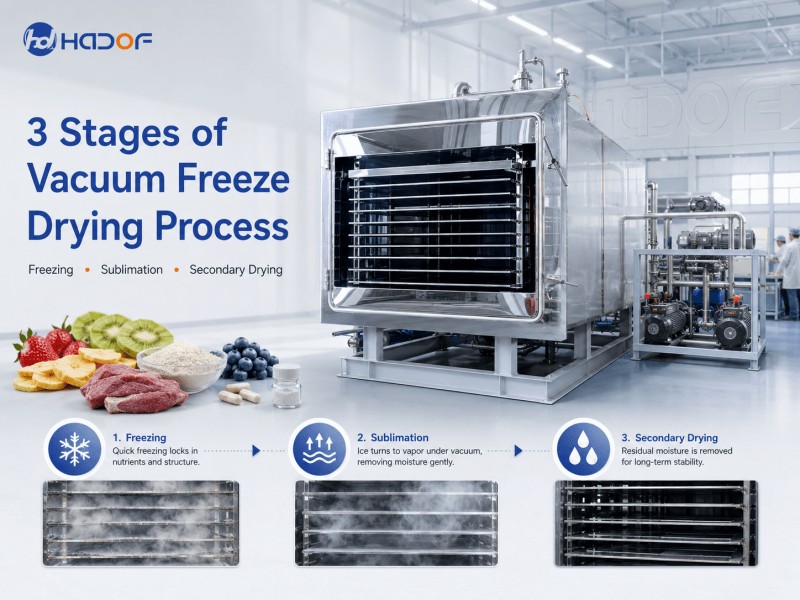
3 Stages Of Vacuum Freeze Drying Process
Stage 1: Freezing
The product is loaded onto heated shelves inside the drying chamber and frozen, typically to between -30°C and -50°C. Freezing speed matters: a faster, controlled freeze produces smaller ice crystals and a more uniform, higher-quality result. At the end of this stage the water inside the product has become solid ice.
Stage 2: Primary Drying (Sublimation)
The chamber is evacuated until the pressure drops below the triple point of water, around 610 Pa (roughly 0.006 atmosphere). Under vacuum, gentle heat is applied to the shelves. Instead of melting, the ice sublimates — it changes directly from solid to vapor. This stage removes most of the free water, typically 90–95% of the total, and is the longest and most energy-sensitive part of the cycle. Precise control of heat and vacuum here is what separates a reliable machine from a mediocre one.
Stage 3: Secondary Drying (Desorption)
The temperature is raised further while the pressure is kept low. This removes the remaining bound water molecules that are physically or chemically attached to the product. The final moisture content typically lands between 1% and 4%, which is low enough for long, stable storage and prevents microbial growth.
The Core Components of an Industrial Freeze Dryer
Every production freeze dryer combines several systems that must work together:
- Drying chamber with heated shelves — holds the trays of product and supplies controlled heat.
- Condenser (cold trap) — captures the sublimated vapor and turns it back into ice so it does not damage the vacuum pump.
- Vacuum system — pulls and holds the low pressure required for sublimation.
- Refrigeration system — drives both the freezing stage and the cold trap.
- Control system (PLC/HMI) — manages temperature, pressure, and time for repeatable batches.
How a Batch Runs, Step by Step
- Loading — prepared, pre-treated product is spread evenly on trays and loaded into the chamber.
- Freezing — shelves cool the product below its freezing point.
- Vacuum pull-down — pumps evacuate the chamber to sublimation pressure.
- Sublimation — gentle heat drives ice directly to vapor while the condenser captures it.
- Desorption — residual bound moisture is removed at higher temperature.
- Unloading and packaging — the dry, brittle product is removed quickly and packed in moisture- and oxygen-barrier packaging.
Each stage is programmed and monitored, so batch after batch comes out consistent.
Why It Matters for Food Production
The payoff for a factory is practical, not just technical. Freeze-dried food is light — often 80–90% lighter than the fresh input — which cuts shipping and storage cost. It rehydrates in minutes, making it ideal for instant soups, ready meals, pet food, camping meals, and premium snacks. And because quality is preserved so well, producers can charge a premium and open export markets that hot-air-dried products cannot reach.
What Can You Freeze Dry?
The same three-stage process adapts to a wide range of products, which is why freeze dryers appear in so many different factories:
- Fruit — strawberries, mango, banana, and apple keep bright color and crisp texture for premium snack and cereal ingredients.
- Vegetables — peas, corn, carrots, and leafy greens become lightweight soup and ready-meal components that rehydrate fast.
- Meat and seafood — shrimp, fish, and diced meat retain protein and structure for high-value convenience foods and pet food.
- Coffee and powders — freeze-dried instant coffee preserves aroma, while herbal and nutraceutical extracts are dried into stable powders without heat damage.
- Pet food and treats — raw and high-protein recipes are freeze dried to lock in nutrition without cooking.
Because the process is gentle and consistent, one well-specified line can often handle several of these product families with only tray and recipe changes.
Choosing the Right Freeze Dryer
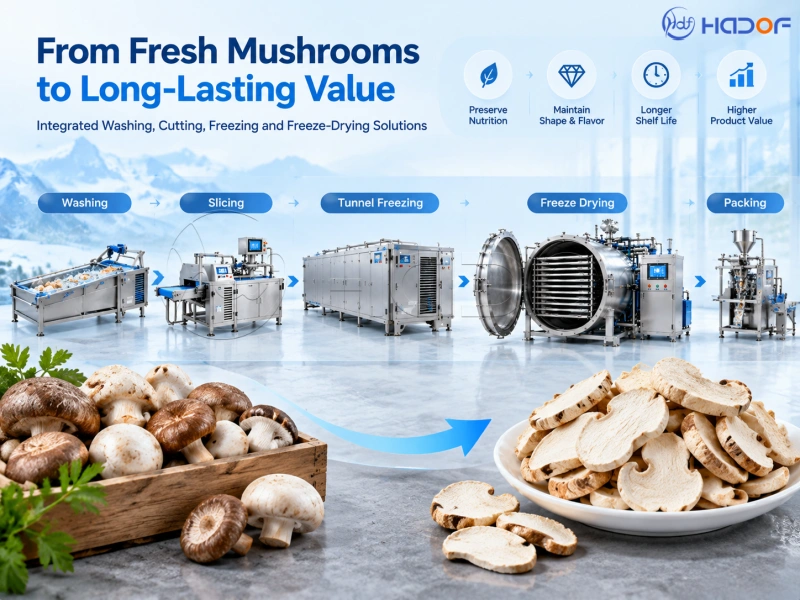
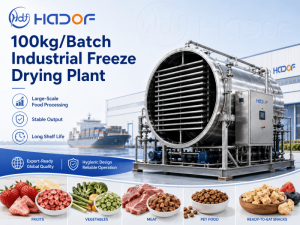
Sizing is the first decision. Batch capacity — commonly 30 kg, 50 kg, 100 kg, or 200 kg per batch — sets your daily output, while shelf area (from 5 m² up to 200 m²) determines how much product fits in one cycle. The right choice depends on your product, its freezing behavior, and your target throughput. A production line also needs the right pre-processing upstream — washing, cutting, and blanching — and proper packing downstream, because a freeze dryer is only as strong as the line around it.
Conclusion
Understanding the three stages of freeze drying — freezing, sublimation, and desorption — makes it much easier to specify the right equipment and run it profitably. If you are planning a freeze-dried food line, HADOF designs complete industrial freeze-drying systems, from pre-processing and freezing to the freeze dryer and packaging. Contact our engineers with your product and target output, and we will help you size the right solution.
















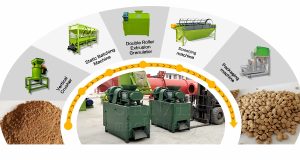










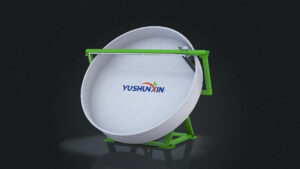
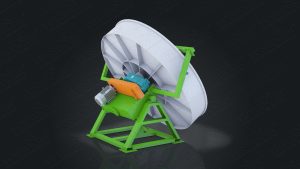
 And you can consider our organic compost machine, when you
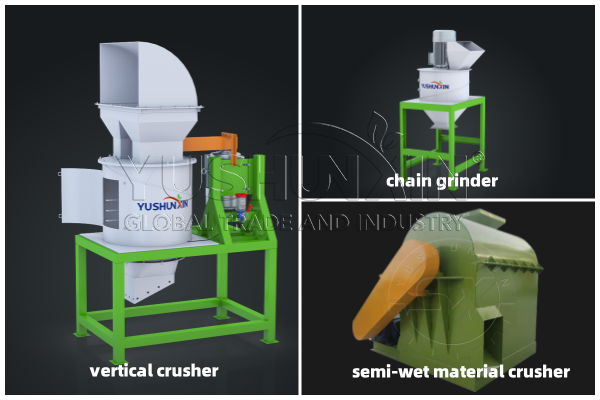
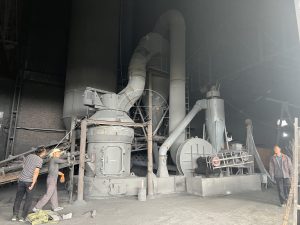
 The crush process and grind process are more important process in


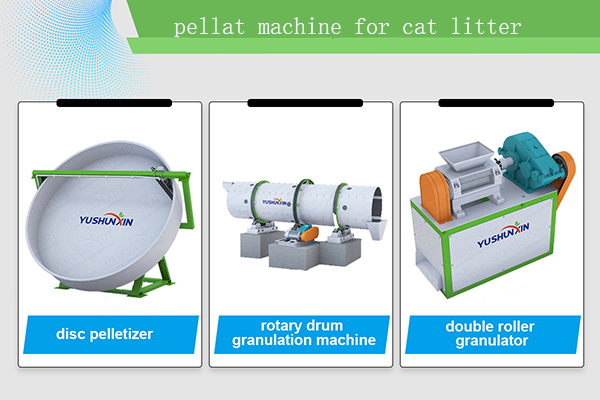
 In the end, if you want to make organic fertilizer and you don’t know how to do it, you can visit my website: