How to Make Granulated Compost Suitable for Mechanical Spreading in Modern Agriculture

Mechanical spreading requires more than converting compost powder into any pellet shape. Granules need a controlled size, rounded profile and sufficient strength to move through storage, conveying and spreading equipment consistently. Therefore, the decision about how to make round organic fertilizer pellets should begin with the compost condition and the spreading method.

Why Does Pellet Shape Matter for Mechanical Spreading?

A broadcast spreader distributes material through a rotating disc or similar mechanism. Irregular lumps, excessive fines and large differences in granule size can affect how compost fertilizer feeds and leaves the spreading equipment.

Controlled round ball organic fertilizer granules production helps create particles that flow more consistently than untreated compost powder. Screening remains important because it separates undersized and oversized material before packaging.

Which Granulator Fits the Required Output?

The target page lists three wet-granulation options with feeding moisture generally controlled at 20%–40%:

  • Rotary drum granulators cover 1–30 TPH and normally produce 3–6 mm pellets.
  • Disc granulators handle 1–6 TPH and allow 1–8 mm size adjustment through moisture and disc-angle control.
  • New-type organic fertilizer granulators process 1–8 TPH and use stirring action to form harder 2–5 mm pellets.

A spherical compost fertilizer granulator should match the prepared compost, hourly capacity and required pellet strength. The crusher, mixer and water-spray system must also supply stable material, while the screener removes off-size granules.
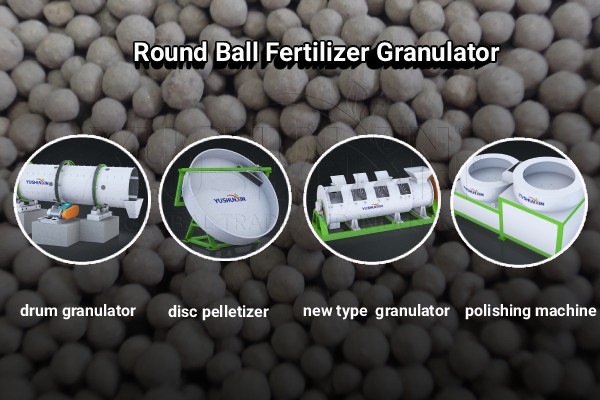
Round ball fertilizer granulators

When Should You Add a Polishing Machine?

Disc and drum granulators already form rounded pellets, so polishing is not always necessary. However, roller presses and flat-die mills produce flatter or cylindrical particles. In this situation, a compost granule polishing machine can smooth edges and improve roundness. The related page lists one-, two- and three-stage models covering 1–8 TPH.

What Should You Confirm Before Ordering?

For reliable compost granules manufacturing for mechanical spreading, provide:

  • Compost type, moisture and particle size
  • Required tons per hour
  • Target granule diameter and strength
  • Intended spreading equipment
  • Bag size and workshop dimensions

These details help the supplier match granulation, screening, drying, cooling and packaging capacity. You can learn more and request a process diagram based on your material:

https://www.granulatedcompostsolutions.com/product/round-ball-compost-pellet-machine/

How Round Compost Pellet Making Machines Can Support Large-Scale Organic Fertilizer Making Operations

In large-scale organic fertilizer production, efficiency, uniformity, and product quality are crucial for meeting market demands and regulatory standards. Round compost pellet making machines, also known as spherical granulators, play a pivotal role in transforming composted organic matter into high-value, uniform fertilizer pellets. Their advanced functionality and adaptability make them a key component in modern large-scale fertilizer manufacturing operations.

1. Enhancing Product Uniformity and Market Appeal

Round pellet machines are designed to produce smooth, spherical compost granules with consistent diameters—typically ranging from 2 mm to 5 mm. Uniform granules are not only easier to handle and package but also improve spreading efficiency for end users. In large-scale operations, product uniformity directly impacts brand reputation, retail packaging, and pricing in competitive markets.

2. Suitable for High-Capacity Production Lines

Modern round pellet machines capacity can range 3–10 tons per hour, depending on the model and compost material. This high output capability ensures they are well-suited for industrial-scale composting facilities and commercial organic fertilizer granulation plants. These machines often serve as the final granulating or shaping step, following rotary drum granulators or flat die extrusion equipment in complete fertilizer lines. learn more.

3. Improving Granule Hardness and Storage Stability

The polishing process in a round pelletizer compacts and shapes granules, increasing mechanical strength and dust resistance. Stronger pellets reduce product loss during storage and transportation—crucial for bulk sales and long-distance distribution. In large-scale operations, minimizing product degradation helps protect the investment and ensures customer satisfaction.

4. Integration with Automated Fertilizer Production Lines

Round compost pellet machines can be easily integrated into automated organic fertilizer granulation systems alongside drying machines, coolers, screening systems, and packaging lines. This streamlined workflow enhances productivity while reducing manual labor costs—an important factor in large-scale fertilizer manufacturing where operational efficiency determines overall profitability.

5. Compatibility with Various Organic Materials

These machines can handle a wide range of organic compost inputs, including chicken manure, cow dung, food waste compost, and agricultural residues. For large plants dealing with variable feedstocks, this flexibility helps maintain stable production and consistent pellet quality.

Conclusion

Round compost pellet making machines are more than just shaping tools—they’re a critical part of high-efficiency, large-scale organic fertilizer production systems. By improving product quality, supporting automation, and accommodating high throughput, these machines help businesses scale profitably while meeting the growing demand for eco-friendly fertilizers. If you are intested in the project, you can visit https://www.granulatedcompostsolutions.com/product/round-ball-compost-pellet-machine/