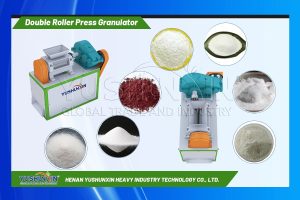
How to Maintain Double Roller Extrusion Granulator for Optimal Performance?

In the quest for optimal performance, the maintenance of a double roller extrusion granulator cannot be overlooked. This guide delves into effective maintenance strategies, raw materials suitable for the machine, and the specific needs and benefits for various industries, ensuring the granulator remains in prime condition.

What Raw Materials Suit Double Roller Extrusion Granulators?

Fertilizer Industry: Versatility and Nutrient Preservation

Double roller extrusion granulators find significant application in the fertilizer industry. Suitable raw materials include urea, ammonium nitrate, and potassium chloride. These materials are compacted into uniform granules, which facilitate easy handling, storage, and application. The granulation process ensures the slow release of nutrients, improving crop yield and soil health. By using these granulators, fertilizer manufacturers can create high-quality products that meet agricultural demands efficiently.

Chemical Industry: Stability and Homogeneity

The chemical industry benefits from the use of raw materials such as sodium bicarbonate, bentonite, and polymers in compact granulators. These materials often require stable and homogeneous granules to ensure consistent reactions and product quality. The granulation process aids in reducing dust, improving flow properties, and enhancing the material’s overall stability. These advantages are vital for various chemical manufacturing processes, contributing to safer and more efficient operations.

How to Maintain a Double Roller Extrusion Granulator?

Regular Inspections and Cleaning

Maintaining a dry granulation machine demands regular inspections and cleaning. Operators should conduct visual checks for wear and tear on rollers, bearings, and other critical components. Cleaning the equipment after each use prevents material buildup, which can lead to operational issues. Regular maintenance extends the lifespan of the granulator and ensures consistent performance.

Lubrication of Moving Parts

Proper lubrication of the moving parts is essential for the smooth operation of a compact granulator. Lubricants reduce friction and wear on components, preventing breakdowns and costly repairs. Operators should follow the manufacturer’s guidelines for lubrication intervals and use recommended lubricants to maintain optimal performance.

Calibration and Adjustment

Calibration and adjustment are vital for maintaining the efficiency of a press granulator. Regular calibration ensures that the machine produces granules of the desired size and shape. Adjustments to the roller gap and pressure settings should be made according to the specific material being processed. These steps help in achieving uniform granulation and meeting product specifications.
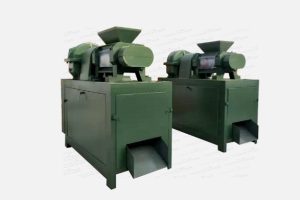
double roller extrusion for carbon-based fertilizer

What Features Enhance the Performance of Double Roller Extrusion Granulators?

Robust Construction and Durability

Double roller extrusion granulators are built with robust construction to handle various materials. Features such as high-quality rollers, durable frames, and reliable bearings contribute to the machine’s longevity and performance. These features ensure that the granulator can withstand the rigors of continuous operation in demanding industrial environments.

Advanced Control Systems

Modern compact granulators come equipped with advanced control systems that allow for precise adjustments and monitoring. These systems enable operators to control parameters such as roller speed, pressure, and feed rate, ensuring optimal granulation conditions. Advanced controls enhance the machine’s efficiency and product quality.

Easy Maintenance and Accessibility

Dry granulation machines are designed for easy maintenance and accessibility. Features like removable rollers, accessible lubrication points, and clear maintenance guidelines simplify the upkeep process. Easy maintenance ensures that the granulator remains in excellent condition, reducing downtime and maintenance costs.

Conclusion

Double roller extrusion granulators, or dry granulation machines, are indispensable across various industries due to their versatility and efficiency. Regular maintenance, including inspections, cleaning, lubrication, and calibration, is crucial for ensuring their optimal performance. With robust construction, advanced control systems, and easy maintenance features, these granulators continue to meet the specific needs of the fertilizer, pharmaceutical, and chemical industries. For those seeking professional solutions, Yushunxin offers high-quality fertilizer equipment tailored to your needs. You can visit: https://www.fertilizerproductequipment.com/double-roller-granulator/

What factors affect the cost of double roller granulation plant

Double roller granulation plant is a popular choice for businesses in the fertilizer industry. It is an efficient way to produce granulated products, which are essential for agricultural use. However, the cost of setting up and running a double roller granulation plant can vary greatly. There are several factors that can affect the overall cost of the plant, and it is important for businesses to consider these factors when planning their investment.

3 tph extrusion granulation line

Raw Material Costs
One of the main factors that can affect the cost of a double roller granulation plant is the cost of raw materials. The type of materials used to produce the granulated products can have a significant impact on the overall cost of the plant. For example, if a business chooses to use high-quality materials, it can result in a higher cost for the plant. Conversely, if a business opts for lower quality materials, the cost of the plant may be lower, but the quality of the final product may also be compromised. Click here to get more details.

Equipment Costs
Another important factor that can affect the cost of a double roller granulation plant is the cost of the equipment. The plant requires specialized machinery to produce granulated products, and this machinery can be expensive. The cost of the equipment can vary greatly depending on the size of the plant, the level of automation, and the specific features of the machinery. And these machines usually use stainless steel as materials.

Labor Costs
Labor costs are another significant factor that can affect the cost of a double roller granulation plant. The cost of labor can vary depending on the location of the plant, the level of expertise required, and the number of workers needed to operate the plant. In areas where labor costs are high, the overall cost of the plant may be higher.

Operational Costs
The operational costs of a double roller granulation plant can also have a significant impact on the overall cost of the plant. These costs can include utilities, maintenance, and other ongoing expenses. The cost of utilities, such as electricity and water, can vary depending on the location of the plant and the local rates. Maintenance costs can also vary depending on the age and condition of the equipment.

Market Conditions
Finally, market conditions can also affect the cost of a double roller granulation plant. The demand for granulated products can fluctuate, and this can impact the cost of the plant. If there is a high demand for granulated products, the cost of the plant may be higher, as businesses may need to invest in additional equipment and labor to meet the demand. Conversely, if there is a low demand for granulated products, the cost of the plant may be lower, as businesses may be able to operate with fewer resources.

In conclusion, there are several factors that can affect the cost of a double roller granulation plant. Businesses need to consider the cost of raw materials, equipment, labor, operational costs, and market conditions when planning their investment in a granulation plant. By understanding these factors, businesses can make informed decisions and ensure that their investment is cost-effective. In addition, choosing a high quality extrusion machine is also important, you can get more information from https://www.granulatorforfertilizer.com/double-roller-granulator/.

How to Select the Ideal Equipment for Your 10 t/h Production Needs?

Selecting the right equipment is crucial for enhancing efficiency and productivity in any production line. This is particularly true for businesses aiming to meet specific production targets such as 10 tons per hour (t/h). When it comes to meeting the demands of a 10 t/h powder granulation production requirement, it is crucial to choose the right equipment that can ensure efficiency and effectiveness.

Section 1: Understanding the Granulation Process

To embark on selecting the ideal equipment, it is essential to first understand the granulation process. Granulation involves the transformation of raw materials into desired granules. It promotes uniformity, improves handling, and enhances the overall efficiency of the production line. By using Yushunxin’s efficient double roller extrusion granulator, the press, compact, and dry granulation methods can be seamlessly applied.

Equipment Selection of Simple NPK Fertilizer Extrusion Granulation Line

Section 2: Key Features of Yushunxin’s Double Roller Extrusion Granulation Production Line

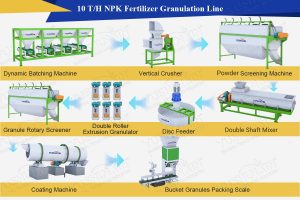
2.1 Loader Type Feeder and Crain Crusher

The first step in any granulation process is the efficient feeding and crushing of raw materials. Yushunxin’s dry granulation production line (10 t/h) excels in this aspect, featuring a state-of-the-art loader type feeder and crain crusher. These equipment ensure a steady material flow and guarantee the timely and effective crushing of the raw materials, resulting in high-quality granules.

2.2 Horizontal Mixer

To achieve a homogeneous mixture and ensure consistent quality throughout the manufacturing process, Yushunxin’s production line incorporates a powerful horizontal mixer. This equipment offers exceptional mixing capabilities, allowing for uniform dispersion of ingredients and minimizing production variations.

10 TPH NPK Fertilizer Granulation Line

2.3 Double Roller Extrusion Granulator

At the heart of Yushunxin’s production line, the double roller extrusion granulator takes center stage. This innovative equipment is designed to efficiently compress and shape the granules, resulting in desired size, density, and shape characteristics. Its robust design ensures long-lasting performance, minimizing downtime and maximizing productivity.

2.4 Rotary Screening Machine

Once the granules are formed, a rotary screening machine is employed to separate oversized and undersized particles, ensuring only the desired granules move forward to the next stage. This crucial equipment promotes product uniformity and guarantees the high-quality output of the production line.

2.5 Automatic Packaging Scale and Belt Conveyors

Completing the granulation process, Yushunxin’s production line integrates an automatic packaging scale and a network of belt conveyors. These equipment streamline the packaging and transportation process, ensuring efficient storage and delivery of the final product.

Click here for more details.

Section 3: Raw Materials and Applications

To provide a comprehensive perspective, it is essential to shed light on the raw materials examples during the granulation process. Yushunxin’s production line effectively handles various materials, including but not limited to organic fertilizers, inorganic fertilizers, and compound fertilizers. It efficiently converts these materials into high-quality granules that cater to the specific needs of agricultural and industrial applications.

NPK Materials for Double Roller Extruder

Conclusion

In conclusion, selecting the right equipment for your 10 t/h production needs is paramount to achieving optimum productivity. Yushunxin’s double roller extrusion granulation production line, with its exceptional features and advantages, offers a reliable solution to meet and exceed your granulation requirements. By leveraging the loader type feeder, crain crusher, horizontal mixer, double roller extrusion granulator, rotary screening machine, automatic packaging scale, and belt conveyors, you can elevate your production capabilities and ensure consistent quality. You can visit: https://www.extruder-granulator.com/10-t-h-npk-fertilizer-granulation-line/

Choose Double Roller Granulator for Making Fertilizer Pellets

Double roller granulator is a popular choice for making fertilizer pellets due to its high efficiency, durability, and versatility. Click here to get more information. Here are some of the reasons why you should choose double roller granulator for making fertilizer pellets:

  1. High Efficiency:

Double roller granulator is designed to produce high-quality fertilizer pellets efficiently. It uses a unique pressing technology to compress the raw materials into granules, which results in a high yield and a low waste ratio.

  1. Durability:

Double roller granulator is made of high-quality materials that are resistant to wear and tear, which means that it can withstand the demands of continuous operation.

  1. Versatility:

Double roller granulator is capable of producing different types of fertilizer pellets, including organic fertilizer, inorganic fertilizer, and compound fertilizer. This makes it a versatile option for farmers and fertilizer manufacturers.

  1. Low Maintenance:

Double roller granulator for fertilizer requires minimal maintenance, which reduces the overall cost of production. Its simple design and few moving parts mean that it is easy to operate and repair.

  1. Environmentally Friendly:

Double roller granulator is an environmentally friendly option for making fertilizer pellets. It reduces the amount of waste generated during the fertilizer manufacturing process and helps to conserve natural resources.

Overall, double roller granulator is an excellent choice for making fertilizer pellets due to its high efficiency, durability, versatility, low maintenance, and environmental friendliness.


A double roller granulator is a machine that uses a unique pressing technology to produce fertilizer pellets. Here are the steps involved in the process of making pellets using a double roller granulator:

  1. Raw Material Preparation:

The first step is to prepare the raw materials for granulation. The raw materials can be in the form of powder, granules or other forms. The raw materials need to be selected and mixed in appropriate proportion to ensure the quality of the pellets.

  1. Feeding:

The prepared raw materials are then fed into the feeding hopper of the double roller granulator.

  1. Granulating:

The feeding system pushes the raw materials into the compacting chamber of double roller granulator https://www.granulatorforfertilizer.com/double-roller-granulator/ , where two rollers compress the raw materials into small, dense granules. The rollers are made of high-quality materials and are designed to exert a high pressure on the raw materials.

  1. Cutting:

As the rollers rotate, the granules are cut into the desired size by a knife that is fixed on the side of the compacting chamber.

  1. Screening:

The granules are then screened to remove any oversize or undersize particles, ensuring that only the desired size pellets are collected.

  1. Packaging:

The finished pellets are then packaged for storage or transportation.

The double roller granulator uses a dry granulation process, which means that no water or binder is added during the process. This makes it a cost-effective and environmentally friendly option for producing high-quality fertilizer pellets.