Freeze Drying vs. Air Drying vs. Dehydration: What Food Factories Should Know

Every food factory that dries product faces the same question: which method should we use? Freeze drying, air drying, and dehydration all remove moisture, but they do it in very different ways and produce very different results. Choosing the wrong method can mean poor rehydration, lost color and aroma, or a cost structure that never pays back. This guide compares the three methods and explains how to choose.

How Freeze Drying Works

Freeze drying freezes the product first, then removes the ice through sublimation under vacuum. The freeze-drying process runs in three stages — freezing, primary drying, and secondary drying — and never uses high heat. The product keeps its structure, color, and aroma, and it rehydrates quickly. This is the most expensive method per kilogram, but it produces the highest-quality result and supports premium pricing.

How Air Drying Works

Air drying uses heated air to evaporate moisture from the product. It is simple, widely used, and relatively inexpensive. Hot air drying is common for grains, herbs, and some vegetables, and it works well when the product does not need to keep its original shape. The trade-off is that heat can shrink the product, darken its color, and reduce heat-sensitive nutrients. Rehydration is slower than with freeze drying.

How Dehydration Works

Dehydration uses low-temperature air over a longer time, often in a dehydrator or drying cabinet. It is gentle enough for some products but still relies on evaporation, so it cannot match the structure and aroma retention of freeze drying. Dehydration is popular for small producers because the equipment is affordable and easy to operate, but it is a slow batch process with limited throughput.
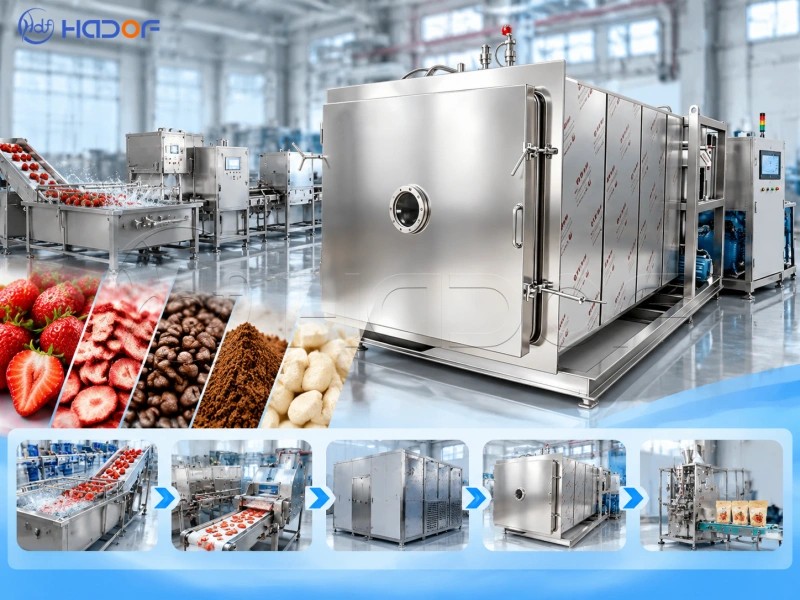
30kg batch Freeze Drying Project

30kg batch Freeze Drying Project

Key Differences

The three methods differ in several important ways:

  • Temperature: freeze drying runs cold; air drying and dehydration use heat.
  • Quality: freeze drying preserves shape, color, and aroma best; air drying can shrink and darken.
  • Rehydration: freeze-dried products rehydrate fastest and most completely.
  • Cost: freeze drying is the most expensive per kilogram; air drying and dehydration are cheaper.
  • Throughput: air drying can be continuous and fast; freeze drying and dehydration are batch processes.
  • Product fit: freeze drying suits high-value pieces; air drying and dehydration suit powders, grains, and simple ingredients.

How the Choice Affects Product Quality

Quality is usually the deciding factor. Freeze-dried products keep their original shape and color, and they rehydrate so quickly that they closely resemble fresh food. Air-dried and dehydrated products are often darker, smaller, and slower to rehydrate, though they can still be perfectly suitable for soups, powders, and ingredients where appearance matters less. Before choosing a method, define what “good quality” means for your product: shape, color, aroma, rehydration speed, or nutrient retention. That definition will point to the right method.

Cost and Throughput Comparison

Freeze drying has the highest processing cost per kilogram because of its long cycles and energy demand, but it supports the highest selling price. Air drying is faster and cheaper, and continuous systems can handle large volumes. Dehydration sits between the two: affordable equipment and gentle drying, but slow throughput. The right comparison is not cost per kilogram alone, but margin per kilogram of finished product. A premium freeze-dried snack can earn more per kilogram than a cheaper air-dried ingredient, even with a higher processing cost.

When to Choose Freeze Drying

Choose freeze drying when quality, aroma, and rehydration are the priorities — for premium fruit snacks, ready-meal ingredients, pet food, seafood, and herbal products. An industrial freeze dryer is the right choice when the product must keep its shape and command a premium price. The higher cost is offset by the product quality and the markets it opens.

When to Choose Air Drying

Choose air drying when the product can tolerate heat, when throughput matters, and when cost per kilogram is the main constraint. An air dryer is often used as a pre-processing step to remove surface water before freezing and drying, which reduces the load on the freeze dryer and improves efficiency.

When to Choose Dehydration

Choose dehydration for small-batch production, simple products, and situations where the capital budget is limited. It is a good way to start, but producers often upgrade to air drying or freeze drying as volume and quality requirements grow.

Can You Combine Methods?

Yes. Many factories use more than one method. Air drying can remove surface water before freeze drying, and dehydration can handle products that do not need premium quality. The key is to match each product to the method that gives the best balance of quality and cost, rather than forcing everything through one process.

Common Mistakes

The first mistake is choosing a method before defining the product and the market. The second is comparing only equipment price and ignoring operating cost and product quality. The third is using air drying for products that need to keep their shape and aroma. The fourth is under-sizing the production line around the dryer. Finally, skipping trial batches makes it hard to confirm that the method produces the quality customers expect.

Conclusion

Freeze drying, air drying, and dehydration are different tools for different products. Freeze drying delivers the highest quality and supports premium prices; air drying and dehydration are cheaper options for products that can tolerate heat. HADOF Food Processing Manufacture supplies freeze dryers, air dryers, and complete production lines, and can help you choose the right method for your product. Tell us what you make and how much you need, and we will help you plan the right process.

How Does a Vacuum Freeze Dryer Work? A Step-by-Step Guide

Freeze drying, also called lyophilization, removes up to 95–99% of a product’s moisture by turning ice directly into vapor — without ever passing through a liquid stage. For food factories, that single difference matters enormously: freeze-dried fruit, vegetables, meat, seafood, and coffee keep their original shape, color, aroma, and nutrition while gaining a shelf life measured in years. In this guide we walk through exactly how an industrial freeze dryer does that, stage by stage.

What Makes Freeze Drying Different

Conventional drying relies on heat. Hot-air dryers and dehydrators evaporate water, but the high temperatures shrink and harden the product, darken its color, and destroy heat-sensitive nutrients such as vitamin C and many flavor compounds. Freeze drying works in the opposite direction: it freezes the product first, then removes the ice in a vacuum at low temperature. The structure stays intact, so the product rehydrates quickly and closely resembles fresh food when water is added back.

The Three Stages of Freeze Drying

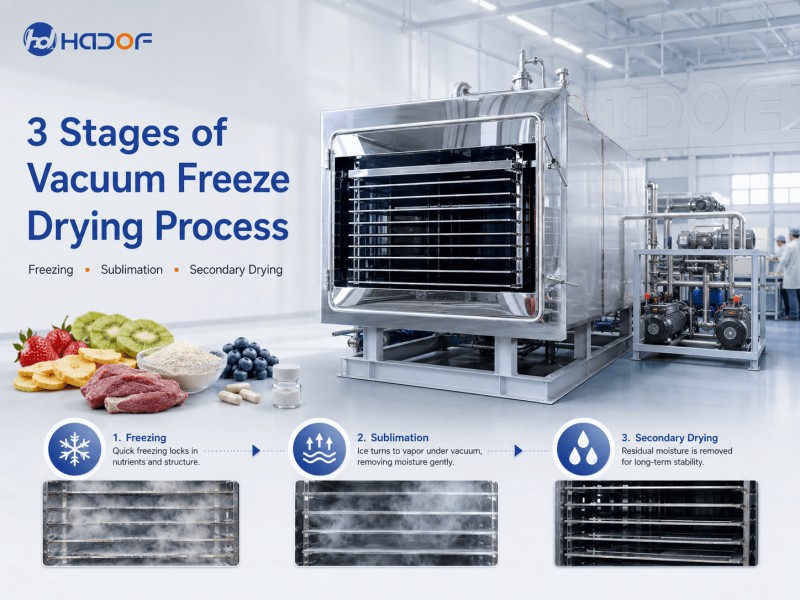
3 Stages Of Vacuum Freeze Drying Process

3 Stages Of Vacuum Freeze Drying Process

Stage 1: Freezing

The product is loaded onto heated shelves inside the drying chamber and frozen, typically to between -30°C and -50°C. Freezing speed matters: a faster, controlled freeze produces smaller ice crystals and a more uniform, higher-quality result. At the end of this stage the water inside the product has become solid ice.

Stage 2: Primary Drying (Sublimation)

The chamber is evacuated until the pressure drops below the triple point of water, around 610 Pa (roughly 0.006 atmosphere). Under vacuum, gentle heat is applied to the shelves. Instead of melting, the ice sublimates — it changes directly from solid to vapor. This stage removes most of the free water, typically 90–95% of the total, and is the longest and most energy-sensitive part of the cycle. Precise control of heat and vacuum here is what separates a reliable machine from a mediocre one.

Stage 3: Secondary Drying (Desorption)

The temperature is raised further while the pressure is kept low. This removes the remaining bound water molecules that are physically or chemically attached to the product. The final moisture content typically lands between 1% and 4%, which is low enough for long, stable storage and prevents microbial growth.

The Core Components of an Industrial Freeze Dryer

Every production freeze dryer combines several systems that must work together:

  • Drying chamber with heated shelves — holds the trays of product and supplies controlled heat.
  • Condenser (cold trap) — captures the sublimated vapor and turns it back into ice so it does not damage the vacuum pump.
  • Vacuum system — pulls and holds the low pressure required for sublimation.
  • Refrigeration system — drives both the freezing stage and the cold trap.
  • Control system (PLC/HMI) — manages temperature, pressure, and time for repeatable batches.

How a Batch Runs, Step by Step

  1. Loading — prepared, pre-treated product is spread evenly on trays and loaded into the chamber.
  2. Freezing — shelves cool the product below its freezing point.
  3. Vacuum pull-down — pumps evacuate the chamber to sublimation pressure.
  4. Sublimation — gentle heat drives ice directly to vapor while the condenser captures it.
  5. Desorption — residual bound moisture is removed at higher temperature.
  6. Unloading and packaging — the dry, brittle product is removed quickly and packed in moisture- and oxygen-barrier packaging.

Each stage is programmed and monitored, so batch after batch comes out consistent.

Why It Matters for Food Production

The payoff for a factory is practical, not just technical. Freeze-dried food is light — often 80–90% lighter than the fresh input — which cuts shipping and storage cost. It rehydrates in minutes, making it ideal for instant soups, ready meals, pet food, camping meals, and premium snacks. And because quality is preserved so well, producers can charge a premium and open export markets that hot-air-dried products cannot reach.

What Can You Freeze Dry?

The same three-stage process adapts to a wide range of products, which is why freeze dryers appear in so many different factories:

  • Fruit — strawberries, mango, banana, and apple keep bright color and crisp texture for premium snack and cereal ingredients.
  • Vegetables — peas, corn, carrots, and leafy greens become lightweight soup and ready-meal components that rehydrate fast.
  • Meat and seafood — shrimp, fish, and diced meat retain protein and structure for high-value convenience foods and pet food.
  • Coffee and powders — freeze-dried instant coffee preserves aroma, while herbal and nutraceutical extracts are dried into stable powders without heat damage.
  • Pet food and treats — raw and high-protein recipes are freeze dried to lock in nutrition without cooking.

Because the process is gentle and consistent, one well-specified line can often handle several of these product families with only tray and recipe changes.

Choosing the Right Freeze Dryer

Sizing is the first decision. Batch capacity — commonly 30 kg, 50 kg, 100 kg, or 200 kg per batch — sets your daily output, while shelf area (from 5 m² up to 200 m²) determines how much product fits in one cycle. The right choice depends on your product, its freezing behavior, and your target throughput. A production line also needs the right pre-processing upstream — washing, cutting, and blanching — and proper packing downstream, because a freeze dryer is only as strong as the line around it.

Conclusion

Understanding the three stages of freeze drying — freezing, sublimation, and desorption — makes it much easier to specify the right equipment and run it profitably. If you are planning a freeze-dried food line, HADOF designs complete industrial freeze-drying systems, from pre-processing and freezing to the freeze dryer and packaging. Contact our engineers with your product and target output, and we will help you size the right solution.

Freeze-Dried Mushroom at Industrial Scale: Tunnel Pre-Freezing Meets a 100kg/batch Plant

Freeze-dried mushroom quality depends on two things: freezing speed and drying vacuum. Button, shiitake, and oyster varieties keep their shape and aroma when a tunnel freezer locks the cell structure first. A 100kg/batch industrial freeze drying plant then removes the ice without heat damage. Hadof sizes that pairing around your own daily output.

Freeze-Dried Mushroom at Industrial Scale Tunnel Pre-Freezing Meets a 100kg batch Plant

Why Does Tunnel Pre-Freezing Decide Freeze-Dried Mushroom Quality?

Freezing speed decides crystal size, because ice forms differently at each cooling rate. A fast tunnel cycle creates small crystals, so cell walls stay intact through drying. Slow freezing grows large crystals, and those crystals tear cell walls apart. Then the freeze-dried mushroom loses shape, aroma, and rehydration performance. An industrial tunnel freezing machine moves loaded trolleys through a cold tunnel on a fixed schedule. Because every trolley meets the same air temperature, each batch enters the chamber evenly frozen. Besides, tunnel freezing matches tray handling, so mushrooms keep one tray depth from freezer to shelf.

How Does a 100kg/batch Industrial Freeze Drying Plant Work?

A 100kg/batch industrial freeze drying plant freezes material first, then dries it under vacuum. Inside the chamber, pressure drops below 5 Pa, so ice turns straight into vapor. Therefore, no liquid water passes through the cell structure. The condenser traps that vapor on cold coils, so the vacuum stays stable. Meanwhile, shelf temperature stays within ±1 °C, which keeps drying uniform across the load. Low-temperature models reach -40 °C, while deep-freeze versions with dual compressors reach -60 °C. This process protects mushroom color, umami compounds, and rehydration ratio.

Which Steps Prepare Mushrooms Before Freezing?

Preparation decides how evenly the load freezes and how fast it dries. Then a bubble cleaning machine lifts soil and casing residue away with water flow. Air bubbles soften the impact, so delicate caps and stems keep their surface. Next, a slicer cuts mushrooms into uniform thickness. A vegetable slicing machine holds slices at 3 mm to 8 mm, so every piece dries evenly. Uneven slices leave wet centers, and those centers shorten shelf life. After that, a dewatering step removes surface water before tray loading.

What Parameters Matter on an Industrial Freeze Dryer?

Parameter choice decides cycle time, energy cost, and product consistency. Check these values before you compare suppliers.

Parameter

Typical Value
Ultimate vacuum ≤5 Pa
Shelf temperature uniformity ±1 °C
Condenser temperature -40 °C or -60 °C, dual compressor for deep freeze
Chamber material SUS304 food-grade stainless steel
Refrigerant R507A
Power supply 380 V, 3 phase, 50 Hz
Defrost method Spray water defrost

Also, ask how the machine handles defrost, because that step affects daily uptime.

How Do You Balance Freezing, Drying, and Packing Capacity?

Capacity balance decides if the line runs smoothly or waits. Such a 100kg/batch freeze drying plant delivers full output only when the freezing section keeps pace. If the tunnel freezes faster than the chamber dries, trays pile up near the door. Therefore, match tunnel throughput to chamber batch size and cycle time. Meanwhile, packing speed should follow the same rhythm, so dried product leaves quickly. Moisture returns fast to freeze-dried mushroom pieces, and slow packing lowers final quality.

What Makes This Line Reliable in Daily Production?

Reliability comes from simple structure, steady control, and quick service. Besides, stainless steel surfaces resist corrosion in wet washing areas. PLC control stores recipes, so operators switch between product types without guesswork. Spray defrost shortens cleaning between cycles, which protects uptime. What’s more, conveyors link washing, freezing, drying, and packing into one workflow.

Hadof is a professional food processing equipment manufacturer. Our factory builds washing, cutting, freezing, and drying equipment, and our engineers design complete lines instead of single machines. We also hold ISO9001 and CE certification, and we serve freeze drying projects worldwide.

One dedicated engineer studies your material, output target, and factory area, so the layout fits your building. Besides, our team handles installation, commissioning, and operator training after delivery. You can contact our team at any time.

For a customized solution, visit the Hadof freeze dryer homepage at https://www.freezehadof.com/.