What is the organic fertilizer production process?

The market for charcoal based fertilizers is gradually increasing nowadays with the demand for sustainable agriculture. Do you want to manufacture charcoal based fertilizer? Then you can read the article, if you want to tour more related knowledge, you can come to my website:https://www.charbasedfertilizermachine.com/product/organic-fertilizer-manufacturing/

1. Raw Material Collection

The first step of organic manufacturing involves gathering the necessary raw materials, which can include:

  • Animal manure (e.g., cow, horse, chicken)
  • Agricultural waste (e.g., straw, husks)
  • Industrial waste (e.g., distiller’s grains, vinasse)
  • Municipal sludge
  • Other organic matter

2. Fermentation

The collected raw materials need to undergo a fermentation process to decompose and stabilize the organic matter. This process is more important in organic making .This can be done using different types of composting equipment:

  • Crawler Turner: This machine turns and aerates the compost pile, speeding up decomposition.
  • Self-propelled Turner: Similar to the crawler turner but is self-propelled for easier maneuverability.
  • Chain Plate Turner: Utilizes chains and plates to turn the compost more efficiently.
  • Horizontal Fermenter: Enclosed fermentation that provides controlled conditions for faster composting.

3. Crushing

After fermentation, the compost is usually passed through a crusher to break down any large clumps, ensuring a fine and uniform texture.

4. Screening

The crushed material is then screened to remove any impurities or large particles that did not fully decompose. A rotary drum or vibrating screen is typically used.

5. Mixing

In this step, additional nutrients or additives may be mixed into the compost to enhance its quality. This ensures a balanced nutrient profile in the final product.

6. Granulation (Optional)

For some types of organic fertilizer, the material is then granulated to form pellets. This is done using a granulator, such as:

  • Disc Granulator
  • Rotary Drum Granulator
  • Flat Die Pellet Mill

Дисковый гранулятор производит бентонитовые гранулы

7. Drying

The granulated fertilizer may need to be dried to reduce moisture content. This is typically done using a rotary dryer.

8. Cooling

After drying, the fertilizer is cooled using a rotary cooler to prevent caking and improve storage stability.

10. Packaging

Finally,when your organic fertilizer making done, then you can packag it using an automatic packing machine. This can be done in bags of various sizes depending on the target market.

Key Equipment in Organic Fertilizer Production

  • Fermentation Equipment: Crawler Turner, Self-propelled Turner, Chain Plate Turner, Horizontal Fermenter
  • Crushing Equipment: Crusher
  • Screening Equipment: Rotary Drum Screen, Vibrating Screen
  • Mixing Equipment: Mixer
  • Granulation Equipment: Disc Granulator, Rotary Drum Granulator, Flat Die Pellet Mill
  • Drying and Cooling Equipment: Rotary Dryer, Rotary Cooler
  • Packaging Equipment: Automatic Packing Machine
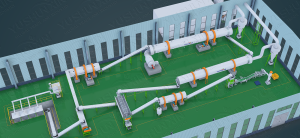
Линия грануляции с вращающимся барабаном
 

Example Production Line for Organic Fertilizer Powder

  1. Fermentation: Using a chain plate turner or horizontal fermenter.
  2. Crushing: Using a high moisture fertilizer crusher.
  3. Screening: Using a rotary drum screening machine.
  4. Mixing: Using a horizontal mixer.
  5. Packaging: Using an automatic packing machine.

Each step in the organic production process ensures that the raw materials are converted into high-quality organic fertilizer that is safe, stable, and rich in nutrients.

If you have specific requirements or need more detailed information about any particular part of the process, and you can click here to free to ask. 

30 Tons per Hour Powdered Carbon-Based Fertilizer Production Line

Introduction

In response to the growing demand for sustainable agricultural practices, the 30 tons per hour powdered organic fertilizer production  is designed to efficiently produce high-quality carbon-based fertilizers. This production line integrates advanced technology to ensure optimal productivity, cost-effectiveness, and environmental sustainability. And if you have any things want to know, you can come my web: https://www.charbasedfertilizermachine.com/product/organic-fertilizer-manufacturing/

Raw Material Handling and Preparation

Raw Material Storage

  • Raw Materials: Biochar, organic waste, minerals, additives
  • Storage Facilities: Silos, bunkers, covered storage areas
  • Material Handling Equipment: Front-end loaders, conveyors, hoppersCrushing and Grinding

Crushing and Grinding

  • Equipment: Jaw crushers, hammer mills, roller mills
  • Purpose: Reduce the size of raw materials for easier mixing and processing

The crush process and grind process are more important process in organic fertilizer making.

Mixing and Blending

 Batch Mixers

  • Types: Ribbon blenders, paddle mixers
  • Function: Homogenize the raw materials to ensure a consistent final product

 Continuous Mixers

  • Types: Twin-shaft mixers, rotary drum mixers
  • Function: Provide a continuous and consistent blending of materials. If you want your organic fertilizer make more fine, then you can buy theses machines when you make powdered organic fertilizer.

    Screening and Grading

     Vibrating Screens

    • Function: Separate granules based on size to ensure uniformity
    • Equipment: Multi-deck vibrating screens

     Oversize and Undersize Granule Handling

Cooling

Secador de tambor rotativo

Rotary Coolers

  • Function: Reduce the temperature of the granules post-drying
  • Purpose: Ensure safe storage and packaging

Packaging

Weighing and Bagging

Equipment Used in an Organic Fertilizer Powder Production Line

An organic fertilizer powder production  involves several key pieces of equipment that work in a specific order to convert raw organic materials into finely powdered organic fertilizer. If you want to learn more details, you can come to my web. Here’s a detailed look at the equipment used and the typical sequence of operations:

  • Composting Turner:
    • Purpose: To compost and ferment organic materials, such as animal manure, agricultural residues, and other organic waste. And it is the most important process in the organic fertilizer powder making.
    • Types: Crawler turner, self-propelled turner, chain plate turner, etc.

Crusher:

  • Purpose: To crush composted materials into finer particles, making them easier to process in subsequent steps.
  • Types: Hammer mill, chain crusher, cage crusher, etc.

  • Screening Machine:
    • Purpose: To separate fine powdered materials from larger particles and impurities.
    • Types: Rotary drum screener, vibrating screen, etc.
  • Mixer:
    • Purpose: To blend different raw materials uniformly, ensuring a consistent nutrient composition in the final product.
    • Types: Horizontal mixer, vertical mixer, etc.

  • Granulator :
    • Purpose: If granules are also desired, a granulator can be included to form pellets from the powdered material. It also the important process if you want to make organic fertilizer powder production line.
    • Types: Disk granulator, rotary drum granulator, etc.

  • Dryer:
    • Purpose: To reduce the moisture content of the material, ensuring it is dry enough for further processing and storage.
    • Types: Rotary drum dryer, fluidized bed dryer, etc.
  • Cooling Machine:
    • Purpose: To cool down the dried fertilizer, making it easier to handle and preventing moisture absorption.
    • Types: Rotary cooler, counter-flow cooler, etc.
  • Packaging Machine:
    • Purpose: To pack the final powdered fertilizer into bags for storage, transport, and sale.
    • Types: Automatic packing machine, semi-automatic packing machine, etc.

Order of Operations in an Organic Fertilizer Powder Production Line

  1. Composting and Fermentation:
    • Organic materials are first collected and placed in a composting area.
  • A compost turner is used to regularly turn the materials, ensuring proper aeration and decomposition.
  • This process can take several weeks to months, depending on the materials and environmental conditions. And is the important process of making organic fertilizer powder prodcution.

  • Crushing:
    • Once the composting process is complete, the composted material is transferred to a crusher.
    • The crusher breaks down the compost into smaller particles, making it easier to handle and process further. This process can make organic fertilizer powder  more small and fine in manufacturing organic fertilizer process.


  • Screening:
    • The crushed material is then passed through a screening machine.
    • The screener separates fine powdered material from larger particles and impurities.
    • The oversized particles may be returned to the crusher for further processing.
  • Mixing:
      • The screened fine powder is transferred to a mixer.
      • Various raw materials, including nutrient additives, can be added to the mixer to ensure a consistent and balanced nutrient composition.
      • Granulation:
        • If granulated fertilizer is also desired, the mixed powder can be sent to a granulator.
        • The granulator forms the powder into pellets of uniform size.
        • This step is optional for a powder production line but essential for producing organic granular fertilizers.
      • Drying:
        • The mixed (and possibly granulated) material is then transferred to a dryer.
        • The dryer reduces the moisture content, ensuring the fertilizer is dry and stable for storage and packaging.
      • Cooling:
        • After drying, the material is typically hot and needs to be cooled down.
        • A cooling machine brings the temperature down, making the material easier to handle and preventing moisture absorption.
      • Packaging:
        • Finally, the cooled fertilizer powder is transferred to a packaging machine.
        • The packaging machine fills and seals bags of the desired size, ready for storage, transport, and sale.

    In the end, if you want to make organic fertilizer and you don’t know how to do it, you can visit my website:https://www.charbasedfertilizermachine.com/product/organic-fertilizer-manufacturing/

Organic Fertilizer Granulation Production Line: A Comprehensive Guide

Organic farming and sustainable agricultural practices have gained significant traction in recent years. One of the critical components of these practices is the use of organic fertilizers. Organic fertilizers making not only enrich the soil with essential nutrients but also improve soil structure and microbial activity. Among the various forms of organic fertilizers making, granulated organic fertilizers production are particularly popular due to their ease of application, storage, and transportation. This article delves into the organic fertilizer granulation production line, exploring its components, processes, and benefits. If you have any questions or problems, you can click my web site: https://www.charbasedfertilizermachine.com/product/organic-fertilizer-manufacturing/

What is Organic Fertilizer Granulation?

Organic fertilizer making is the process of converting organic materials into small, uniform granules. This process enhances the physical properties of the fertilizer, making it easier to handle and apply. Granulated fertilizers also release nutrients more slowly compared to their powdered counterparts, providing a steady supply of nutrients to plants over an extended period.

organic fertilizer production line

Components of an Organic Fertilizer Granulation Production Line

An organic fertilizer granulation production line process typically comprises several key components:

Composting System:

  1. The initial step involves composting organic materials such as animal manure, crop residues, and kitchen waste.
  2. Composting helps in the decomposition of organic matter, reducing its volume and eliminating harmful pathogens.

Crushing Machine:

  1. After composting, the material is usually coarse and needs to be crushed into finer particles.
  2. The crushing machine reduces the particle size, making it suitable for granulation.

Mixing Machine:

The crushed materials are then mixed with other additives such as peat, bone meal, or beneficial microbes.

A mixing machine ensures a uniform blend of all ingredients, which is crucial for consistent granule quality.

organic fertilizer production line

Granulator:

  1. The core component of the production line is the granulator.
  2. There are various types of granulators, including rotary drum granulators, disc granulators, and new-type organic fertilizer granulators manufacture.
  3. The granulator shapes the mixed materials into granules through mechanical processes.

Drying Machine:

  1. Newly formed granules often contain excess moisture, which needs to be removed to ensure stability and longevity.
  2. A drying machine reduces the moisture content to the desired level.

Packaging Machine:

  1. The final step is packaging the granules into bags for storage and sale.
  2. Packaging machines can handle different bag sizes and ensure airtight sealing.

Benefits of Organic Fertilizer Granulation Production Line

Nutrient Efficiency:

Granulated organic fertilizers provide a slow and steady release of nutrients, enhancing nutrient uptake by plants.

Improved Soil Health:

The organic matter in the granules improves soil structure, water retention, and microbial activity.

Ease of Application:

Granules are easier to spread evenly across fields, ensuring uniform nutrient distribution.

Storage and Transportation:

Granulated fertilizers are less prone to caking and can be stored and transported more efficiently than powdered forms.

organic fertilizer production line

Conclusion

The organic fertilizer granulation production line plays a crucial role in modern organic farming practices. By transforming organic waste into nutrient-rich granules, this process not only supports sustainable agriculture but also contributes to environmental conservation. As demand for organic products continues to rise, the importance of efficient and effective organic fertilizer production lines will only grow. Investing in this technology can yield significant benefits for farmers, consumers, and the planet. You can come to my web to learn more information about organic fertilizer production line.