For a ready-to-eat salad manufacturer, the cost of a complete 500 kg/h leafy salad processing line cannot be determined by capacity alone. The final investment depends on the vegetables being processed, the required washing stages, moisture-control targets, packaging method, workshop layout, automation level, and local utility conditions. A realistic quotation should therefore describe the complete process rather than list one washing machine and call it a production line.
What Should a Complete 500 kg/h Salad Line Include?
A ready-to-eat salad factory normally needs to control the product from raw vegetable reception to final packing. A practical production flow may include:
- Raw vegetable receiving and temporary storage
- Manual inspection, trimming, and root removal
- Leaf separation or size reduction
- Adjustable cutting
- Vortex washing and impurity separation
- Secondary rinsing
- Vibrating draining
- Centrifugal dehydration
- Optional surface air drying
- Weighing, bagging, sealing, and date coding
The exact configuration depends on whether the factory processes whole lettuce leaves, shredded cabbage, spinach, celery, herbs, or mixed salad vegetables. These materials are all classified broadly as leaf vegetables used as salad greens, but their structures and handling requirements are different.
Whole leaves may need gentler conveying and washing. Cut lettuce and shredded cabbage require better control of floating fragments and surface water. Spinach can carry sand between folded leaves and may need soaking or multiple washing stages. Therefore, the raw material mix directly affects equipment selection and cost.
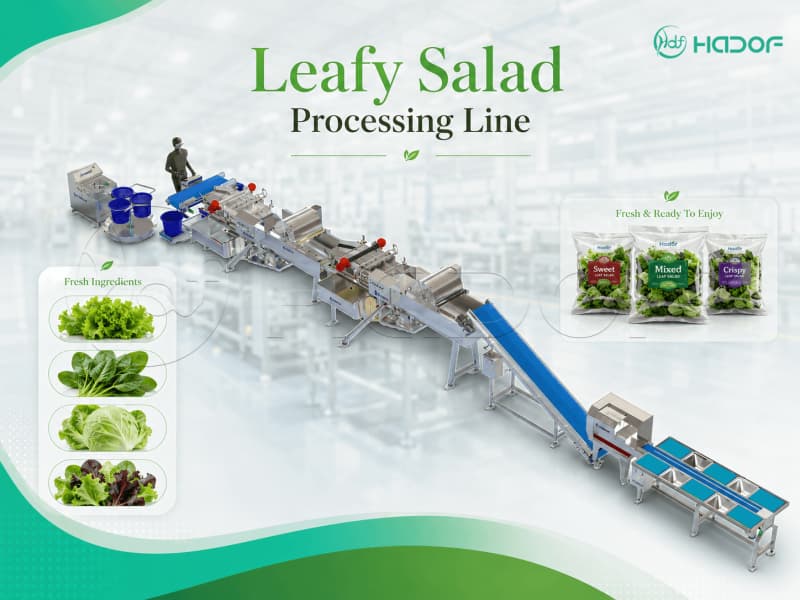
Which Equipment Has the Greatest Influence on the Price?
Sorting and Cutting Equipment
A basic project may use a manual stainless-steel sorting table, while a larger factory may require a longer inspection conveyor with multiple workstations. Cutting costs also change according to the required cut size, feeding width, blade configuration, variable-speed control, and the number of products processed on the same machine.
A factory producing several salad recipes should consider the time required for blade replacement, cleaning, and product changeovers. A lower initial machine price may not represent a lower operating cost if frequent product changes create long stoppages.
Washing and Water Management
The washing section is usually a major part of the investment. A single washing stage may be suitable for relatively clean raw material, but vegetables with more sand, soil, insects, or floating impurities may require soaking, two-stage washing, overflow separation, filtration, and a final clean-water rinse.
The choice between vortex and bubble washing should be based on leaf size and condition. Vortex flow is commonly considered for cut and delicate leafy vegetables, while large whole leaves may need a gentler bubble-washing stage. Buyers can study the principles of industrial leafy green washing and dewatering technology before deciding how many washing modules their factory needs.
Water circulation tanks, removable filters, pumps, spray pipes, and sediment-discharge structures add to the purchase price. However, they may also make water management and daily cleaning more practical. The supplier should clearly distinguish recirculated washing water from the clean water used for the final rinse.
Dewatering and Surface Drying
Washing is only half of the process. Excess water can affect package appearance, product handling, weighing accuracy, and downstream operations.
A vibrating drainer removes free water after washing and can provide a final spray rinse. A centrifugal dehydrator then removes more moisture from the leaves. Its operating time and speed should be adjustable for different vegetables. An air dryer may be added when the product specification requires further surface-water removal before packing.
Not every factory needs every drying module. A central kitchen supplying vegetables for same-day cooking may accept a simpler configuration. A retail ready-to-eat salad factory may place greater importance on controlled dewatering and packaging preparation.
How Does the Packaging Method Change the Investment?
Manual bagging and sealing require less initial equipment investment, but they depend more heavily on labor and operator consistency. Automatic weighing and packaging can support continuous production, but the suitable system depends on bag size, target weight, number of salad recipes, packaging film, sealing method, labeling, and required production speed.
Before requesting a quotation, decide whether the project needs:
- Manual weighing and bag sealing
- Semi-automatic weighing
- Automatic weighing and pillow-bag packaging
- Modified-atmosphere packaging integration
- Metal detection, check weighing, or date coding
Optional inspection and packaging equipment should be quoted separately so that buyers can distinguish essential machines from later expansion modules.
Why Does Factory Layout Affect the Cost?
Two production lines with the same nominal capacity may have different conveyor lengths and connection requirements. A straight layout is simple, but an L-shaped or U-shaped arrangement may fit the available workshop better. Drainage direction, floor slope, cleaning access, raw and finished product routes, and packaging-room separation should be reviewed before manufacturing begins.
Buyers should provide a workshop drawing showing:
- Available length, width, and ceiling height
- Doors, columns, walls, and restricted areas
- Water inlet and drainage positions
- Electrical supply and voltage
- Raw material entrance
- Packaging and finished-product exits
- Operator passages and sanitation areas
Without this information, a supplier can only prepare a preliminary estimate.
What Information Is Needed for an Accurate Quotation?
When requesting an automatic leafy salad processing line quotation for food factories, provide more than the phrase “500 kg/h salad line.” A useful inquiry should include:
- Names and photographs of the vegetables
- Whole-leaf or cut-product requirements
- Required cutting sizes
- Dirt and sand conditions
- Incoming and finished-product capacity
- Number of washing stages expected
- Final surface-moisture requirements
- Manual or automatic packaging preference
- Daily operating hours and production shifts
- Workshop dimensions and preferred layout
- Local voltage, frequency, and phase
- Water-supply and drainage conditions
- Destination country and delivery location
This information helps the supplier prepare a configuration list, utility schedule, layout proposal, and conditional price range.
How Should Buyers Compare Different Quotations?
Do not compare only the total price. First, check whether each quotation contains the same process stages. One supplier may quote only cutting, washing, and draining, while another includes sorting, centrifugal dehydration, conveyors, air drying, and packaging.
Buyers should compare:
- Equipment included and excluded
- Food-contact material
- Effective processing width
- Adjustable operating parameters
- Water filtration and circulation design
- Cleaning and maintenance access
- Spare parts supplied
- Installation responsibilities
- Operator training scope
- Delivery conditions
- Warranty terms
- Utility and workshop requirements
Food factories, central kitchens, supermarket suppliers, chain catering companies, and project investors can also review Hadof food processing equipment engineering support when evaluating whether the supplier can connect individual machines into a complete processing workflow.
Is a Modular Line Better for a New Salad Factory?
A modular configuration can reduce the initial investment when production demand is still developing. The factory may begin with sorting, cutting, washing, vibrating draining, centrifugal dehydration, and manual packing. It can later add another washing stage, an air dryer, automatic weighing, or packaging equipment.
However, future expansion should be considered in the first layout. Reserve sufficient space, electrical capacity, drainage access, and conveyor connection points. Otherwise, adding equipment later may require expensive workshop changes.
Final Purchasing Recommendation
The right 500 kg/h salad line price is the cost of a configuration that matches the raw material, final product, hygiene plan, packaging format, and available factory—not simply the cheapest equipment list.
Before making a purchasing decision, ask for a detailed process flow, equipment list, workshop layout, utility requirements, quotation scope, and excluded items. This approach gives food processors a clearer investment basis and reduces the risk of discovering missing production stages after installation. You can visit: https://www.hadofps.com/solutions/leafy-salad-processing-line/